01
Understand the request
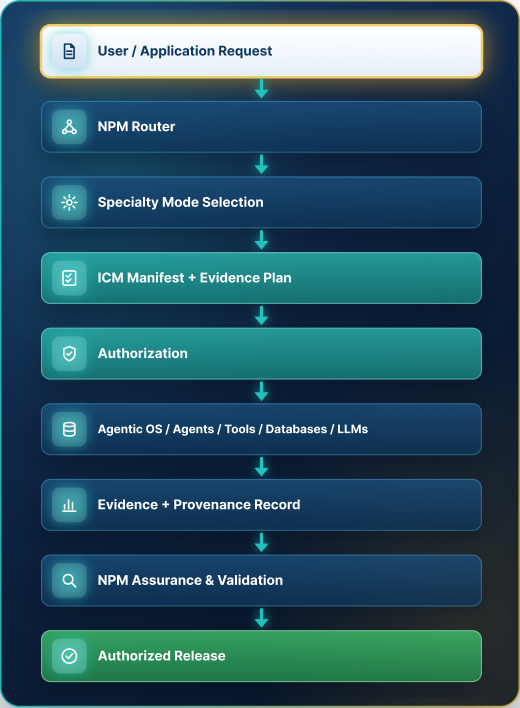
NPMIntegrator receives a request from an application, user, API, wizard, enterprise system, or third-party service.
The Router determines what the request is actually asking the system to accomplish.
06
Select the appropriate LLM or execution resource
Once the task and evidence requirements are understood, NPMIntegrator can select an approved LLM, specialist agent, private model, local model, API, enterprise system, or combination of resources.
Model selection becomes part of governed routing rather than a fixed architectural dependency.
This vendor-neutral principle is consistent with enterprise AI control architectures in which models, APIs, private runners, enterprise systems, and human experts are execution resources beneath the governance layer rather than the governance system itself.
02
Classify the professional context
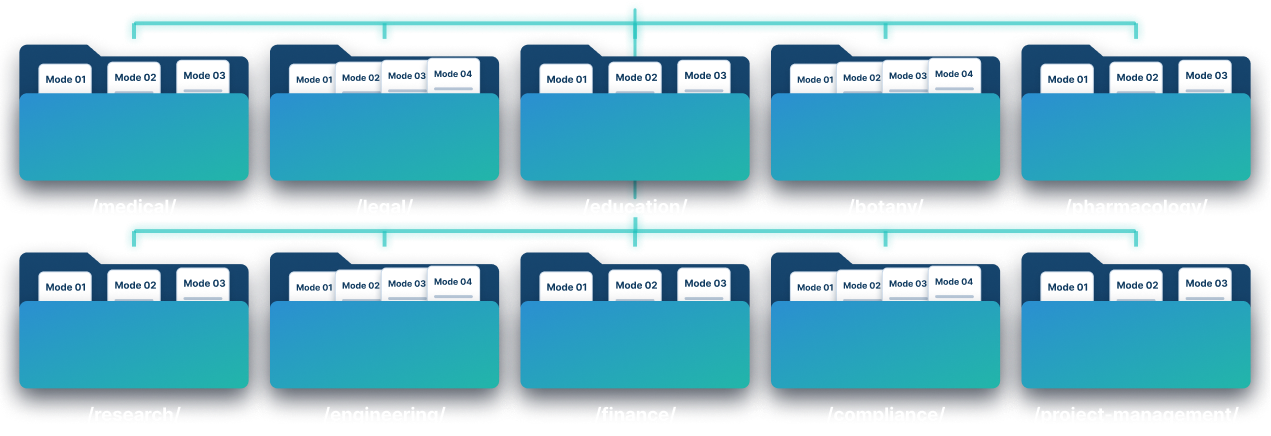
The request is evaluated against available specialty descriptions and Mode Packages.
A botanical research request should not automatically use the same operating context as an educational-development request, legal analysis, clinical workflow, or pharmacological research task.
The Router selects the specialty mode whose declared purpose and permissions best correspond to the requested work.
07
Authorize execution
Before specialist work begins, the request can pass through an execution authorization gate.
A request can be:
execution may proceed.
execution may proceed only after specified conditions or approvals are satisfied.
the requested action is outside permitted policy, capability, data access, or risk boundaries.
The agentic OS therefore receives an authorized scope rather than an unrestricted request.
03
Resolve the Specialty Mode Package
The selected Mode Package supplies the role-specific operating context for execution.
Rather than constructing a new specialist prompt from scratch every time, NPMIntegrator can invoke a governed, versioned Mode Package whose behavior is known in advance.
08
Execute through the Agentic OS
Authorized work is passed into the agentic execution environment.
The underlying OS can then coordinate approved LLMs, specialist agents, enterprise connectors, databases, APIs, and tools.
NPMIntegrator remains the governance and routing layer controlling the conditions under which those resources operate.
04
Compile the ICM manifest
NPMIntegrator combines the request with the selected Mode Package and applicable governance requirements to create an execution manifest.
The manifest can identify:
the selected specialty mode
permitted knowledge sources
approved databases
permitted LLMs
permitted agents
permitted tools
evidence requirements
applicable policies
review requirements
execution constraints
validation requirements
09
Record provenance
The execution record can capture which mode was selected, which model or agent acted, what knowledge sources were accessed, which tools were called, what evidence supported the response, what decisions occurred, and what approvals were granted.
Provenance is particularly important for enterprise AI because the system must be capable of showing not merely the answer, but how the answer was produced.
05
Select the appropriate knowledge
The Router can then direct the request toward the knowledge resources appropriate to that specialty.
That may include an enterprise knowledge base, structured database, document repository, vector search system, authoritative external data source, specialty API, private knowledge collection, or other approved evidence source.
The knowledge-selection decision can therefore be driven by the professional mode and the request, rather than relying solely on whatever information happens to be available to a general-purpose language model.
10
Validate before release
Completion of generation does not automatically mean authorization to release.
The NPM Assurance and Release Plane can inspect the resulting artifact for evidence coverage, provenance, citations, contradictions, missing information, policy requirements, safety requirements, required human review, and artifact integrity.
Only after these controls are satisfied can the final artifact receive release authorization.